What time do 2026 World Cup matches kick off?
Last updated
2026 World Cup matches will kick off at staggered times across multiple time zones in the United States, Mexico, and Canada. Group-stage matches typically begin in early afternoon and continue into evening hours at each venue, with kickoff times coordinated to maximize global viewership while accommodating the host countries' diverse time zones.
All official match times are published in UTC (Coordinated Universal Time), requiring fans to convert to their local time zone for accurate scheduling. The tournament's unique tri-national format means simultaneous matches may occur up to four hours apart in local time.
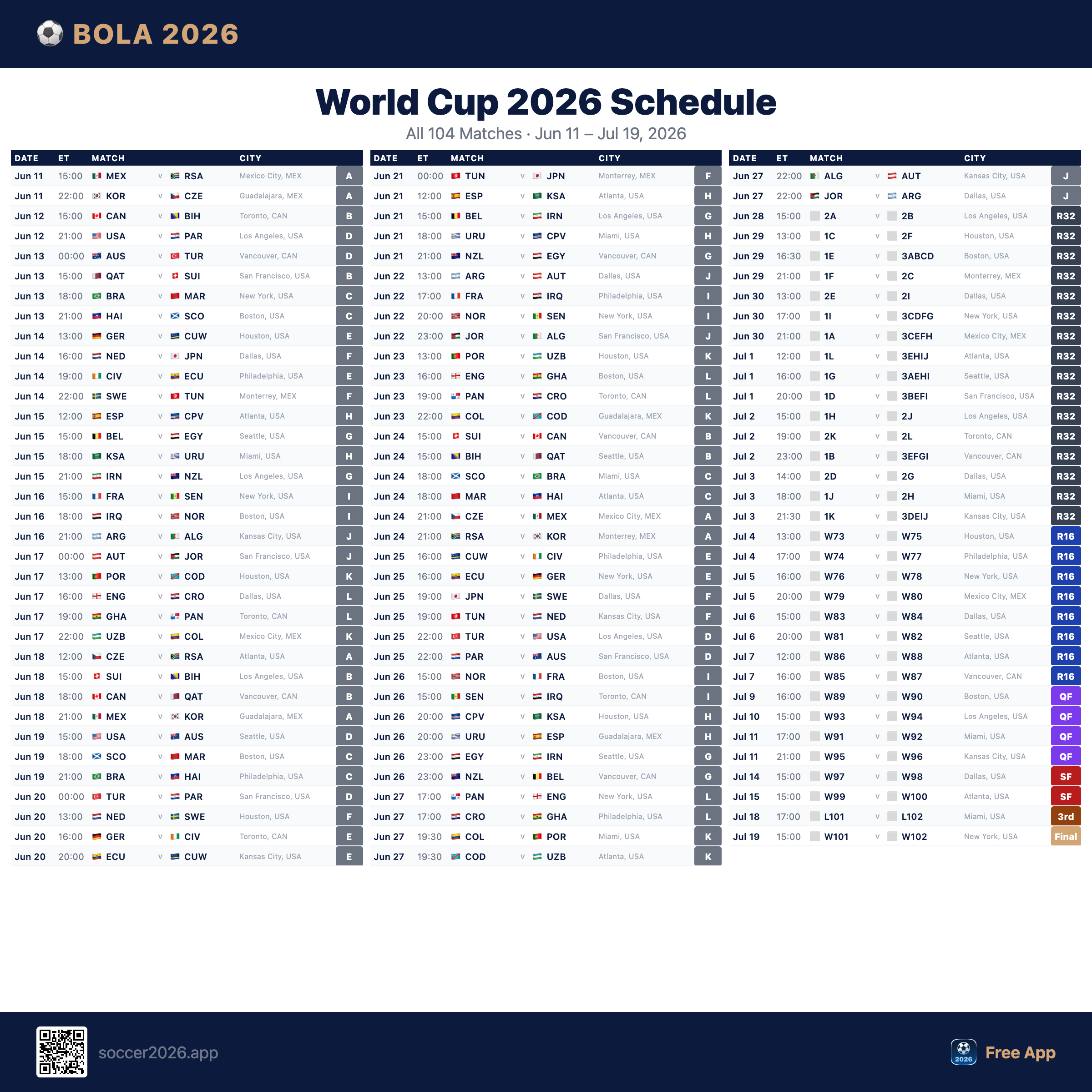
Understanding 2026 World Cup Scheduling
The 2026 World Cup's unprecedented tri-national hosting arrangement creates a complex scheduling matrix. Unlike previous tournaments held in a single country or neighboring time zones, matches will span from Pacific Time in the western United States to Eastern Time, encompassing Mexican Central Time and various Canadian zones. This geographic spread requires careful coordination to ensure fair rest periods between matches while maintaining broadcast-friendly windows for global audiences.
Converting UTC to Your Local Time
FIFA publishes all official match times in UTC to provide a universal reference point. Fans attending matches or watching from home should convert these times to their local zone. For reference, during the tournament period, UTC converts to: Eastern Time (UTC-4), Central Time (UTC-5), Mountain Time (UTC-6), and Pacific Time (UTC-7), assuming daylight saving time is in effect. Platforms like Bola 2026 allow fans to track live scores and view schedules automatically converted to their preferred time zone.
Frequently asked questions
Why are 2026 World Cup times given in UTC?
FIFA uses UTC as the universal time standard to avoid confusion across the tournament's multiple time zones spanning three countries, ensuring consistent global scheduling.
How many time zones will host 2026 World Cup matches?
The tournament will span at least four time zones across the United States, Mexico, and Canada, from Pacific Time to Eastern Time.
Will all group stage matches start at the same local time?
No, group-stage matches are staggered from early afternoon into evening at each venue, accommodating both local attendance and global broadcast windows.